
A new opener has to cope with a door that stiffens in January and a garage that may never see heat. The drive type, the motor size and the door's springs all matter more here than the brand. Here's how belt, chain, screw and wall-mounted drives compare, and why the door gets checked before any of them goes up.
Tell us what the door is doing. The estimate is free and precedes everything else.
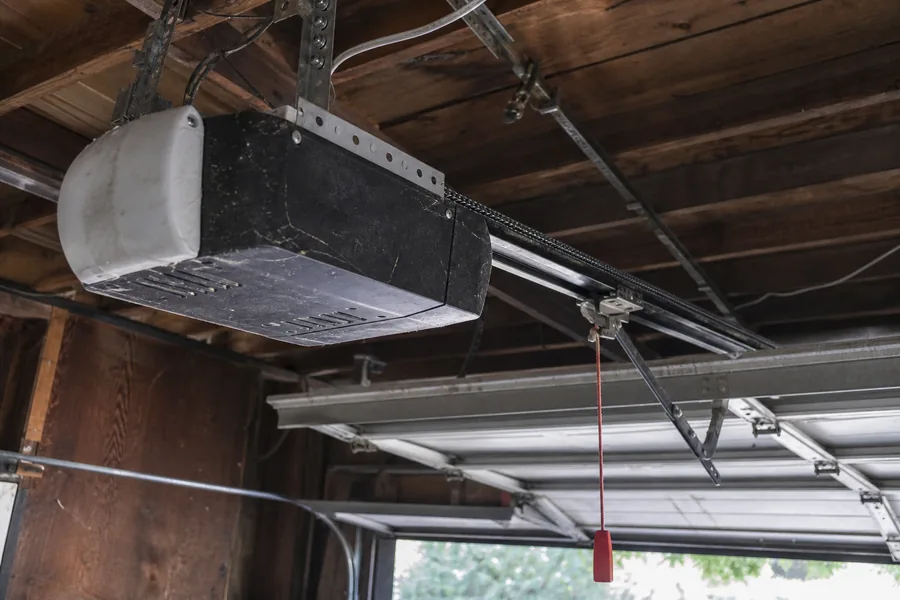
Overhead openers all follow one layout: a motor near the back wall drags a trolley along a rail, and an arm links the trolley to the door's top section. The drive is the thing doing the dragging, whether a roller chain, a belt with steel cords, or a threaded rod. The motor, rail and trolley stay the same whichever drive you choose.
A wall-mounted opener skips the rail. It bolts beside the door and turns the torsion bar, keeping the motor out of the coldest air under the roof and leaving the ceiling free.
Around town, most attached garages get belts, many detached alley garages get chains, and garages with full or low ceilings get wall-mounted units.
Heated garages are the exception worth knowing about: a garage kept above freezing is easier on every opener, and that's where a belt drive shows its quiet best.
A detached alley garage is still a sensible place for a chain. An attached garage, especially one under a bedroom, is where a belt earns its place.
Insulated doors change the math. Plenty of owners here switch to an insulated door to keep the garage warmer, and the extra weight means both the springs and the opener's motor have to be sized for it.
Foam panels glued to the back of an old door add weight the same way, and they're a common reason springs and openers wear out early.
Five steps, every time.
The LiftMaster, Chamberlain and Genie lineups now build in Wi-Fi: your phone shows the door's position, can close it from anywhere, and sends a message whenever it moves.
For anyone who winters elsewhere, that message and the ability to close the door remotely are the features that matter most.
A backup battery runs the opener through an outage for a number of cycles. Ice storms and summer thunderstorms both cut the power, and that's when the car has to get out.
Adding surge protection at the opener's outlet is a small step that protects the circuit board through summer storm season.
Winter outages tend to arrive with ice storms, when the car is the only way out and the door is heavy with ice, so a backup battery earns its keep here.
The names we hear most are LiftMaster's belt units with battery backup and Wi-Fi and Genie's quieter belt models. Both work well; their lifespan comes down to the door.
Horsepower numbers are mostly for the box. A balanced single door asks very little; heavy insulated doubles ask more; and no motor rating makes up for a door that's out of balance.
Screw-drive openers still hang in some older garages. Their grease thickens in the cold, they slow and grind in January, and they're usually replaced rather than rebuilt.
Plenty of calls for a new opener in Winnebago County end with the old one staying. It was struggling because a spring had weakened, a salt-rusted cable was fraying, or cold grease had stiffened the rollers. Fix those and it keeps working.
The coldest week of the year exposes it: a worn spring breaks on a below-zero morning, the opener hauls against dead weight, and the opener gets blamed for the spring's failure.
Snow melting off the car and refreezing under the door is another winter culprit: the bottom seal sticks to the floor, the opener pulls, and something gives.
The estimate is free and comes first. You'll hear what the door needs and which opener fits before anything is decided, and no is always an acceptable answer.
"Belts can't handle heavy doors." Steel-reinforced belts are rated for insulated doubles; springs set the real limit.
"Just get a stronger motor." A laboring opener is reporting an unbalanced door; more horsepower just postpones the breakdown.
"Wi-Fi openers mean a monthly plan." The standard apps are free; optional paid tiers add things like video history.
"Reuse the old rail." It rarely fits another brand, so the new opener's own rail goes up with it.
Yes, and most of all in a bedroom over or beside the garage. A chain clanks through the joists; a belt hums.
In nearly every case, once the door is balanced. Springs, cables and rollers are checked first, and every moving part gets a lubricant rated for below-zero mornings.
Most of an afternoon, with every clicker and car set up and the safety reverse tested twice.
Then a wall-mounted unit makes sense: it bolts beside the door and turns the torsion bar, so racks and storage stay put. It relies on torsion springs, which most attached garages here use.
It will, across Winnebago County and the nearby towns, and it covers what the door needs and which opener fits before any decision.
Often. A dead opener on a freezing morning with the car shut inside gets handled as urgent. Mention the cold and whether the door is frozen to the floor.
Rolling Green to Machesney Park, one phone call gets you a two-hour window, and you get a call when the technician is on the way.
Free estimate. Throughout Winnebago County, including Churchill's Grove, Signal Hill, Rolling Green, Loves Park, Machesney Park, Belvidere, Roscoe, Rockton, Cherry Valley.
Describe what the old opener is doing and you'll have an arrival window; the visit and the estimate are free across Winnebago County.
Easier to explain by phone? Call (815) 446-3251.
Brand, age and what it's doing now. The estimate is free and comes first.