
Road salt, a shovel blade, a bumper backing out of the alley or a limb from a summer storm: a garage door here takes its hits one section at a time. OnPoint Pro Doors Rockford replaces the damaged section when it can still be matched, tells you plainly when it can't, and the estimate is free.
Tell us what the door is doing. The estimate is free and precedes everything else.
On most doors the bottom section takes the worst of it. It sits in the slush that rolls off the car, it freezes to the slab on the coldest nights, and it catches every pass of the snow blower and the shovel. Road salt works into the seam along the bottom edge, and by the time rust shows on the face, the steel behind it is often thin.
Higher up, the damage is usually a single blow: a car nosing in too far, a ladder that slid, a branch that came down in a July storm. A crease across one section can keep a door from bending smoothly over the curve of the track, and that is when a dent turns into a door that binds or jumps a roller.
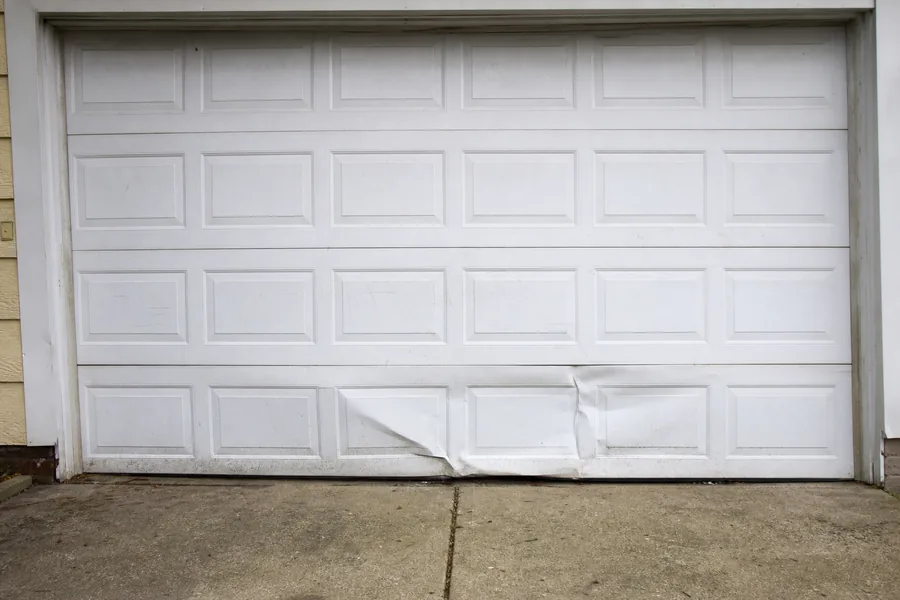
A sectional door is built from separate horizontal sections joined by hinges, so a single damaged one can often come out on its own. The deciding question is whether the maker still produces that design, in that width and height, with the same panel pattern and the same thickness. Many common steel doors from the last couple of decades are still supported, and a new section can be ordered to fit.
Older doors are harder. A raised-panel pattern that was discontinued years ago, a wood door from the old core of town, or a door whose maker is gone may have no matching section anywhere. When that's the case, you hear it at the estimate, along with what a new door would involve, so the choice is made with the facts in front of you rather than after a part fails to arrive.
A new section arrives in the factory color. A door that has faced west through fifteen summers has faded, and the difference can show, especially on white and almond doors. The options are laid out honestly: some owners live with a slightly brighter bottom section, some have the whole door painted to even it out, and some decide a new door is the better move.
Window sections bring their own questions. A cracked insert can sometimes be changed without touching the section, while a bent frame around the glass usually means the whole section.
Many split-levels on the east side have a bedroom or family room over the garage, and their doors are often insulated. An insulated section is a different part from a single-layer one, and mixing the two in one door leaves a cold, rattly stripe across it. The replacement is matched to what the rest of the door is built from, so the door stays as quiet and as warm as it was.
On wide two-car doors, a horizontal steel strut across a section keeps it from bowing in the wind and sagging over time. If the damaged section had one, the new one gets one too, and if the door never had struts on a section that is clearly bowing, that's noted on the estimate.
In the older neighborhoods the garage often opens onto an alley, and the door takes knocks a street-facing door never sees: a trash cart blown into it, a car swinging wide to make the turn, a plow ridge piled against the bottom on a February morning. Those doors are frequently older, lighter steel or wood, which is exactly where a matching section is hardest to find.
For a detached alley garage that is used mostly for storage, a sound single section and a well-balanced door is often all it needs. For one that houses the car every night, the estimate looks at whether the door as a whole has a few good winters left in it.
Every section adds weight, and a new one rarely weighs exactly what the old one did, especially if the old one had rusted thin or had ice packed into its seams. The springs above the door were set for the door as it was. After a section change, the technician sets the balance again so the door holds still at waist height and the opener isn't straining against extra pounds.
Hinges and rollers on the sections next to the damage are looked at in the same visit. A blow hard enough to crease one section often bends the hinge above it or knocks a roller stem out of true, and leaving those in place just moves the problem one section up.
Most section jobs take two visits: one to measure and order, one to install.
Often, yes. If the maker still produces your door's design and size, the bottom section can be ordered and swapped on its own. The estimate tells you whether that's possible for your door.
A shallow dent that doesn't touch the hinges or the bend over the track is mostly cosmetic. A crease across a section, or one that makes the door shudder at the curve, is worth having looked at before it pulls a roller out of the track.
It will match the design and size. The color may be brighter than a door that has faded in the sun for years, and you hear that before anything is ordered.
Then a single section usually can't be matched, and the estimate lays out the alternative: a new door sized to the opening, with the springs set for its weight.
Surface rust can be treated, but rust that has eaten through the steel or swollen the seam usually means the section. Salt does most of that damage here, and it often hides behind the bottom seal.
Yes. A cracked insert can sometimes be changed by itself; a bent window frame usually means the whole section.
Rarely. The door is rebalanced so the opener carries the same light load it was built for.
Yes. The technician looks at the damage, identifies the door and gives you a free estimate before anything is ordered.
We need three things: a name, a number, and what the door is doing. Everything before you agree to it asks nothing of you, across the whole of Winnebago County.
Easier to explain by phone? Call (815) 446-3251.
Tell us what the door is doing. The estimate is free and precedes everything else.