
Garage door spring repair, new doors, openers and general service in South Beloit, right on the Wisconsin line, for the older homes by the river and the newer subdivisions farther out. The estimate is free.
Tell us what the door is doing. The estimate is free and precedes everything else.
Many of the older homes near the river have modest garages: single doors, detached buildings, and doors that have been repaired more than once over the years. Farther out, newer houses have attached garages with insulated steel doors. Both go through long, hard winters, and both show it in their springs and rollers.
Whatever kind of door you have, the visit starts the same way: the door lifted by hand to see how it's really doing.
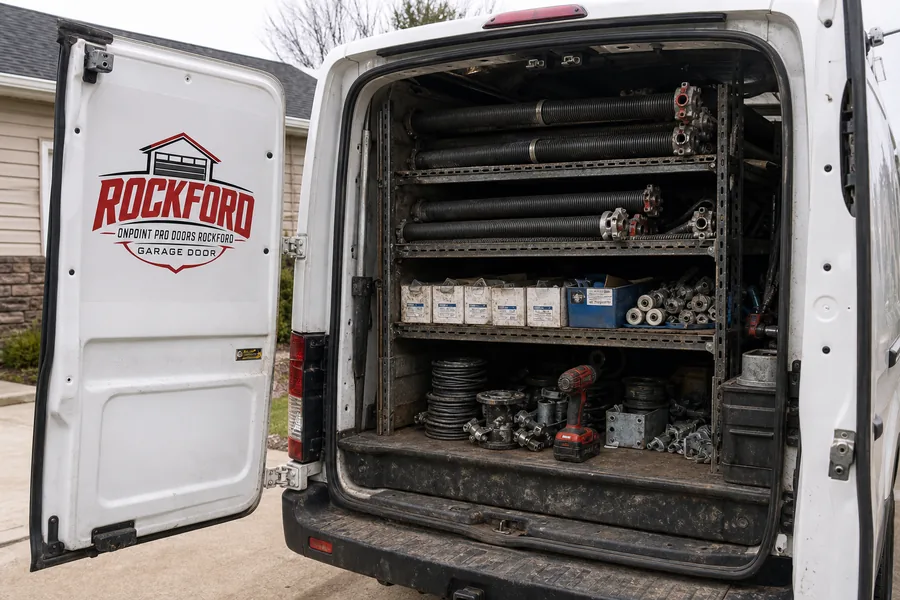
A spring breaking sounds like a gunshot in the garage. Afterward the door won't budge, or rises a few inches and quits, because the opener is now carrying the whole weight. Don't keep pressing the button, and don't pull the release with the door open; without the spring it can drop. New springs go in as a pair, chosen for the door's weight, and the door's balance is checked by hand before the opener is reconnected.
Many older doors here use extension springs that run along the horizontal tracks. When one of those snaps with nothing running through it, the pieces can fly across the garage. Replacement pairs each get a safety cable down the middle, which keeps a future break contained.
Every time, in this order.
Say so when you call if a car is trapped; it's one of the first questions anyway. Until the springs are replaced, the door has to stay where it is, so please don't prop it on a board or try to raise it with a jack. A door without working springs can come down hard.
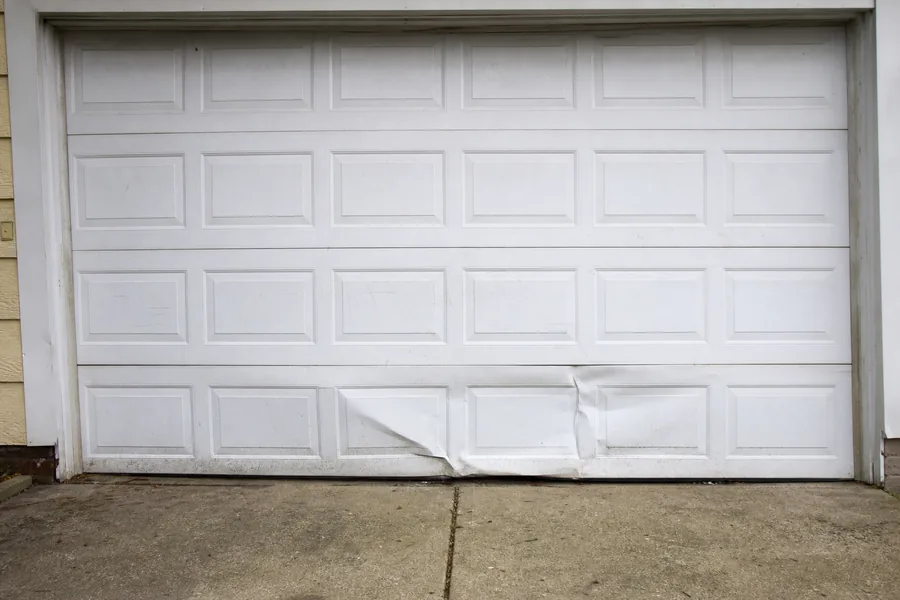
When a door is dented, rusted through or warped, a new one is often the better choice. The main decisions are insulation, well worth having on an attached garage in a place with winters like these, the panel style, windows, and color. Measurements are taken on site, floor included, since older slabs are often uneven.
New tracks and springs sized to it come with the new door, and the old door is removed.
On a modest older house, a simple door usually looks best: a short raised panel or a plain flush design, a row of windows if the garage is dark, and a color that matches the trim. Older garages often have a narrower opening than newer ones, so the door may need to be ordered to the existing size instead of a stock one.
Most opener calls are sensors knocked out of line, remotes that quit, a gear worn smooth or a board damaged by a power surge. Those are repairs. A new opener makes sense when an old fixed-code unit suffers a big failure, and battery backup is worth having on any new unit.
A hum with no movement usually means the drive gear inside has worn through. A click and nothing else points to the circuit board or the wall button. A door that starts down and heads back up is the safety sensors or the force setting. A remote that only works right next to the door usually has a weak battery, or the antenna wire on the motor unit is damaged. All of those are repairs, not reasons for a new opener.
A general service opens with a balance test, the opener unhooked and the door raised by hand. Then the springs are looked over for rust and gaps, the cables for fraying, the rollers and hinges for wear, and the tracks for bends and loose bolts. Moving parts get a lubricant meant for cold weather, the weatherseals are checked, and the opener's force and safety reverse are tested before the technician leaves.
Months of cold stiffen grease, crack weatherstripping and make tired springs brittle, which is why so many broken springs turn up in the first cold weeks. A service in the fall, before that first cold stretch, catches most of it.
A door knocked by a car, or one whose cable snapped, can slip its rollers out of the track and hang at an angle. Leave it closed if it is, keep the opener unplugged, and keep everyone clear; a door hanging like that can shift without warning. It's rehung, the bent track straightened or replaced, and the whole door rebalanced.
Wood and older steel doors often carry coat after coat of paint, which can glue hinges stiff and add weight. Freeing or replacing the hinges and checking the springs against the door's real weight often brings back a door that had become hard to lift.
Detached garages and small shops get the same service as attached ones. Doors on unheated buildings take more abuse in winter, so their rollers and seals are worth checking every year.
Rockton, Roscoe and Machesney Park are served by the same crew.
That's almost always a broken spring. Don't move the door; call, the repair is usually done on the same visit.
Yes. Two springs share every lift, so when one goes, its partner is worn to the same point.
They're fine if each has a safety cable through it. Replacements always get one.
For an attached garage, yes; it keeps the garage warmer and runs more quietly.
A power surge often damages the circuit board. Replacement boards for the major brands travel on the truck.
Usually a weak battery or a damaged antenna wire on the motor unit, both quick repairs.
Worn springs, or springs too weak for the door's weight. Matching springs to the door fixes it.
Yes. Simple panel styles and a trim-matched color suit most older homes, and the opening is measured first.
Yes, any door, attached or not.
Nothing at all. It's free, it's on paper, and you decide.
Use the phone or the form to book a time; the technician calls before arriving.
No work begins until you've looked over the free written estimate.
We need three things: a name, a number, and what the door is doing. Everything before you agree to it asks nothing of you, across the whole of Winnebago County.
Easier to explain by phone? Call (815) 446-3251.
Tell us what the door is doing. The estimate is free and precedes everything else.